
Quantum Research at the Simons Institute
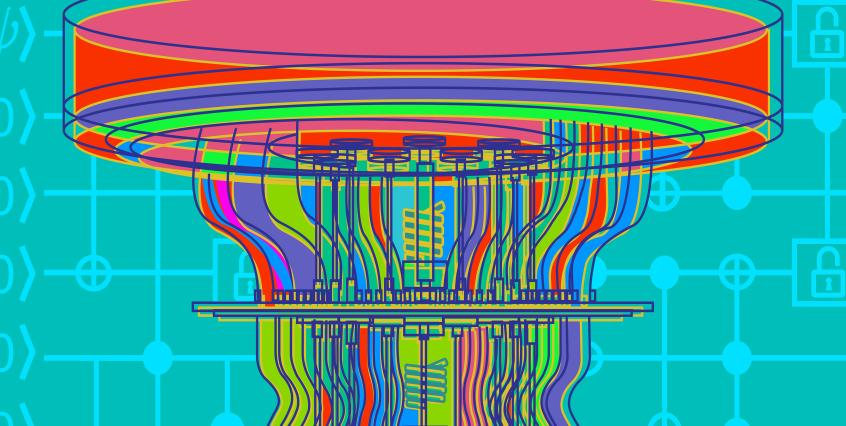
In the wake of the National Quantum Initiative, the Simons Institute’s Research Pod in Quantum Computing brings together researchers from computer...
A Sloan Research Fellowship is one of the most prestigious awards available to early-career researchers.
We’re delighted to share that Miller fellow and Simons Institute Quantum Pod postdoc Ewin Tang has been awarded the 2025 Maryam Mirzakhani New...
The Simons Institute for the Theory of Computing has received a $300,000 grant from the UC Noyce Initiative to hold a research program on Cryptography...
421 videos
This workshop will explore fundamental questions in quantum algorithms. What are the most promising avenues for novel quantum speed-ups: are they in quantum simulation, in quantum machine learning, in new algorithms for post-quantum crypto, in algorithms for quantum learning or testing? And what are the prospects for concrete speed-ups on near-term devices: what are the relevant cost models, which architectures are more noise-tolerant?
This workshop will explore questions around the testing of quantum devices. This includes different models for testing, such as the single- and multi-device models, classical or limited quantum verifiers, and information-theoretic security versus computational assumptions. Workshop themes encompass the foundations of quantum mechanics, classical and quantum cryptography (device independence, delegated computation), and complexity theory (classical and quantum probabilistically checkable proofs).
The workshop is being live streamed on our website. Full participation (including the capacity to ask questions) will be available via Zoom webinar.
This workshop will explore questions around the testing of quantum devices. This includes different models for testing, such as the single- and multi-device models, classical or limited quantum verifiers, and information-theoretic security versus computational assumptions. Workshop themes encompass the foundations of quantum mechanics, classical and quantum cryptography (device independence, delegated computation), and complexity theory (classical and quantum probabilistically checkable proofs).
The workshop is being live streamed on our website. Full participation (including the capacity to ask questions) will be available via Zoom webinar.
The Summer Cluster on Quantum Computing brings together researchers from academia and industry to explore topics from quantum complexity theory and cryptography to quantum algorithms, benchmarking, error correction, and fault tolerance. The cluster...
This program brings together researchers from computer science, physics, chemistry, and mathematics to address current challenges in quantum computing, such as the efficiency of protocols for fault-tolerant quantum computation, scalable proofs of...
The Summer Cluster on Quantum Computing will bring together researchers from academia and industry to explore topics from quantum complexity theory and cryptography to quantum algorithms, error-correction and fault tolerance, and benchmarking. ...
This program will bring together researchers from computer science, physics, chemistry and mathematics to focus on the two grand challenges of quantum computation: developing the most promising algorithmic applications for quantum computers, and...
Quantum Hamiltonian complexity is an exciting area combining deep questions and techniques from both quantum complexity theory and condensed matter physics. This interdisciplinary program will explore these connections and seek to establish a...
Quantum Research at the Simons Institute
The Simons Institute offers a variety of Quantum related programming from the ongoing Quantum Pod to semester long focused Quantum programs and clusters. We host Quantum related workshops, lectures, and activities such as the recurring Quantum Colloquium series and Quantum Industry Day. Much of this is made possible thanks to funding from the Quantum Pod and its grantors.